
COPYRIGHT © 2025 WELLPAL CREATIVE
LightDark


“Build Instruments. Not Ornaments”
Featured
-

DIY Series - The MVB Kit
$25.00
Recent Lemon Seeds

Copyright © 2025|2026 WellPal Creative
The WPC Briefing | understanding the ripples of change
The Underpants Problem
Why Your AI Adoption Strategy Has No Step 2
what are these?
Purpose of The WPC Briefing
a layered perspective
In this Briefing:
Most organizations have a broken AI adoption strategy, not really because the tools are wrong, but because the middle is missing.

They have a Step 1 (we're building AI capabilities) and a Step 3 (we'll lead the market or some other "wish"). What they don't have is Step 2: the actual mechanism by which a tool becomes an advantage/instrument. A February 2026 Mercor study tested AI agents from the three major labs on 480 real workplace tasks, and every agent failed to complete most of what it was assigned.

Meanwhile, individual operators are functionally running the output of hundreds-person teams using the same tools. The gap between those two realities isn't a technology problem. It's a design problem (not the kind solved with a brand refresh. The kind solved by rebuilding how work actually gets done), most organizations haven't started solving it.
The WPC Briefing Series exists to give leaders a decisive edge. It doesn’t revisit theory or drown you in data for deep dives; there’s our Lemon Seeds. Instead, it distills emerging shifts in technology, culture, and competition into sharp, actionable insight. It’s brief by design. Readers already know the frameworks; what they need is a cheat sheet into WPC’s outlook on technology disruption, brand shifts, strategy, and business models, something they can use to spark discussions, refine direction, and navigate complexity with confidence.
*This briefing is written to be of independent reading value, but it does build strongly on our previous brief: AI Strategy Delusion: Why 98% Fail at Coordination
table of contents
Jump Straight to the Essentials
Let's get into it
Executive Summary
Let’s forget the whole AI hype non-sense for a minute.
The organizations losing ground right now aren’t behind on AI tools; to the contraary I think we can all agree, there is more than enough. In my experience, and it seems that of independent studies and publications behind as well, a different problem persists. The one that sits between having the technology and getting the results. The June issue of MIT Technology Review named this “the missing step between hype and profit”. In our thinking is going to be commonly referred to as: “Step 2.” And most business/brand strategies don’t have one at the moment.
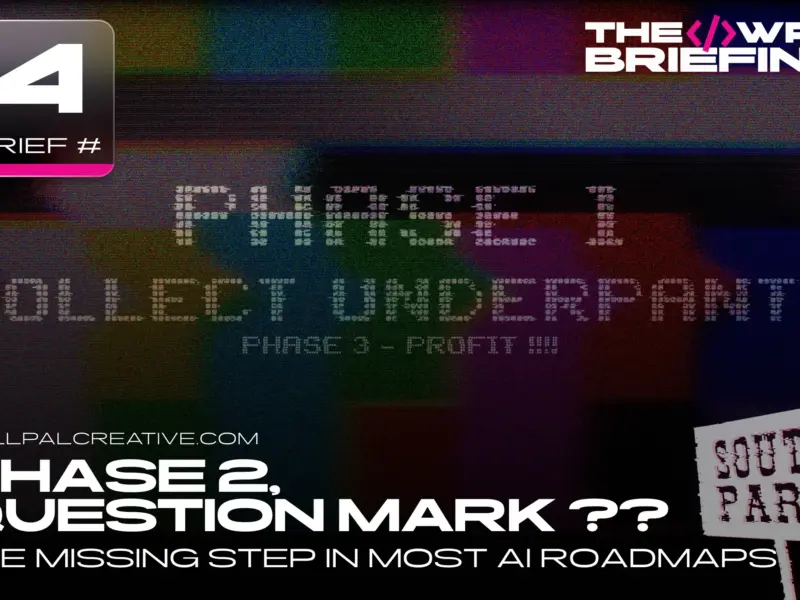
There is this episode of South Park that puts it plainly (the one with the underpants gnomes): Phase 1, collect underpants. Phase 2, question mark. Phase 3, profit. It’s funny because the logic is absurd (and it should be even to those without a business degree). It’s also uncomfortable because the same structure is running inside most AI roadmaps, with considerably more money at stake.
The February 2026 Mercor study mentioned earlier shows the technology side of the problem: the tools still fail most of what they’re assigned. But the human side is stranger and all too often overlooked in the current stage of the hype cycle. Individual operators are achieving productivity multiples that would have required departments a year ago. Not because they have different tools. Because they built a Step 2.
"AI isn't a strategy. It's a tool. What you build with it, how you restructure around it, and whether your team knows how to use it without a babysitter, that's your strategy."
The bifurcation is already here: organizations treating Step 2 as a design problem are zooming out. They’re not waiting for better models (incremental at best at this point) or clearer use cases; they’re rebuilding workflows, redefining roles, and asking hard questions about what work should look like when AI is genuinely integrated. Adoption to them is treated as the beginning of a redesign process, not the end of a procurement or lay-off cycle.
Organizations treating it as a waiting room are in a different position entirely. They’re paying for tools that make their existing confusion faster and more expensive. They’ve purchased the tools, assigned them to teams, and now they’re expecting transformation to arrive on its own, as if the technology will eventually “click,” and the promised productivity gains will materialize without anyone having to redesign how decisions get made, how work gets routed, or what humans are actually accountable for.
In the meantime, they’re paying licensing fees, burning tokens, and watching AI contribute to more expensive, accelerated confusion: bad processes execute quicker, unclear accountability spreads wider, and operational confusion compounds at scale. The tools aren’t the problem.
SECTION 1
THE ANATOMY OF A STUCK STRATEGY
The Three Failure Modes of Step 2
The tools aren't the problem. The pattern is. Here's what it looks like when Step 2 quietly collapses.
Every organization stalled in the middle is failing in one of three predictable ways. Naming them is the first act of diagnosis.
Failure Mode 1 — The Cleanroom Fantasy
The assumption: AI will slot neatly into existing workflows. The reality: it won’t.
The tools don’t land in a controlled environment; they land in organizations contaminated with legacy processes, competing priorities, and people who have been doing things a specific way for years.
The AI can generate a first draft in seconds, but the approval process still requires four people across three time zones and takes two weeks. The AI can analyze customer data beautifully, but that data lives in six different systems that don’t talk to each other, maintained by teams with different reporting structures and conflicting incentives. The AI can automate a task, but the person whose job just got faster now has no clear mandate for what to do with the recovered capacity, so they fill it with email, meetings, and the kind of low-grade busywork that expands to fill available time.
This is what expensive Step 1.5 looks like: more capability, same dysfunction, higher overhead.
The cleanroom fantasy fails because it treats AI adoption as a technology problem when it’s actually an organizational design problem. We need to get in the habit of restructuring the question from “Can the tool do the job?” to “Can the organization absorb the tool without the surrounding systems, incentives, and workflows being deliberately restructured to support it?”
The answer, almost always, is no.
The organizations that navigate this successfully do something uncomfortable: they map the actual workflow end-to-end before deployment, identify every handoff, every approval gate, every place where information gets stuck or duplicated, and ask, with genuine honesty, “If we were building this process from scratch today, knowing what AI can do, what would we keep and what would we kill?”
That exercise is Step 2. And most organizations never do it, because it requires admitting that the current way of working might be fundamentally misaligned with the capability they just purchased. So instead, they slot the AI into the existing mess and wonder why the transformation didn’t show up.
Failure Mode 2 — The Coding Fallacy
The productivity stories coming out of AI-assisted development are real (in some cases, a healthy dose of scepticism should apply). A non-programmer building a functional app over a weekend. A “CEO” running the equivalent of a large engineering operation solo. These are legitimate signals, but they’re being misread.
The productivity multiples that matter in software development, where the output is literally code, don’t translate cleanly to domains where the output is judgment, relationships, or cultural authority. If your brand builds equity because of how you make decisions under ambiguity, how you build trust over time, or how you create meaning in a category that didn’t exist before, a faster code loop is not your Step 2. It’s someone else’s entirely.
The dangerous version of this failure mode is when leaders treat AI coding productivity as a stand-in for all AI productivity, and begin evaluating every function, every role, and every team against a benchmark that doesn’t apply. Marketing doesn’t have a “400X” multiplier waiting in Claude Code. Neither does brand strategy, customer success, or operations.
What they do have are decision-making workflows, coordination costs, and friction points that AI could sharpen or eliminate, but only if someone does the design work of identifying them, naming them, and restructuring around them.
That’s Step 2. And it doesn’t look like coding at all.
Failure Mode 3 — The Information Vacuum
When Step 2 is undefined, a void forms, and it fills with whatever went viral this week. Without a clear internal model of how AI should change operations, organizations become permanently reactive: reorganizing around external noise, chasing capability announcements, and mistaking activity for progress.
This is the failure mode that looks the most like motion. Teams are meeting. Budgets are being reallocated. Pilots are being launched. But the criteria for what gets pursued and what gets killed shift with every new headline. One week, it’s autonomous agents. The next is multimodal search. Then it’s AI-native workflows.
The technology changes faster than any organization can absorb it, and without an internal anchor, leadership defaults to tracking the conversation rather than shaping it.
The observable symptom: strategic whiplash. Priorities that were locked in last quarter get quietly deprioritized because a competitor announced something adjacent. Roadmaps get rewritten not because internal learning changed the strategy, but because external signaling made the current direction feel outdated. Your organization is moving, but it’s moving in response to the market’s surface activity, not its own strategic logic (which is, in my opinion, one of the worst ones to recover from).
The cost isn’t just wasted effort or token burning. It’s actually much deeper, its erosion of internal credibility. When teams watch leadership reverse course repeatedly without clear reasoning, they stop taking the roadmap seriously. Execution becomes performative. People learn to wait out the current priority because another one is coming.
Actionable Insight
Implement the “AI Feasibility Gate.”
Before your next AI investment decision, write down 3 things: 1. What specific workflow or decision is changing? 2. Who owns that change? 3. How will you know it worked? If you can't answer all 3 in one sentence each, you're still in Step 1, regardless of what the tools can do.
The WPC Take
"Capability without redesign is just expensive habit."
- Operational behavior is your brand’s operating system. When AI changes how work gets done, but no one redesigns what work gets done, the brand promise and the delivery start to contradict each other quietly and consistently.
- The organizations pulling ahead aren’t using more AI. They’re using it in fewer, more intentional places.
Your moat: knowing exactly which decisions AI should sharpen, which tasks it should replace, and which human judgments must stay human, and being willing to write that down before the next vendor demo.

SECTION 2
BEYOND THE QUESTION MARK
What Step 2 Actually Looks Like
Four principles separate the organizations that have built a Step 2 from the ones still buying their way into step one.
Step 2 is more of a design posture than a technology milestone. The organizations that have done it share one visible behavior: they treat the space between adoption and outcome as a deliberate problem to solve, instead of a phase to endure.
4 principles
What separate the ones who've built a Step 2 from the ones still describing it.
Redesign before you automate.
The fastest way to destroy value with AI is to automate a process that was already broken. AI makes a bad workflow faster and more expensive to unwind later.
The corrective discipline: Map the job-to-be-done first. Not the current process, the actual outcome the process is supposed to produce.
Then ask: If we were building this from scratch today, knowing what AI can actually do, what would we keep and what would we kill?
That question is uncomfortable because it forces you to confront how much of the current workflow exists for historical reasons, political reasons, or no defensible reason at all. But answering it honestly is what separates Step 2 from expensive Step 1.5.
The organizations doing this well treat AI adoption not as an optimization layer on top of existing operations, but as an invitation to rebuild from first principles. They’re willing to kill sacred cows. They’re willing to admit that the process everyone’s been defending for five years was designed for a world where AI didn’t exist, and that world is gone.
Measure friction, not features.
Most AI strategies begin with the technology’s capabilities and work backward to find use cases. The problem with this approach is that it optimizes for what’s technically possible rather than what’s operationally valuable. You end up with AI doing impressive things that don’t actually move the constraint.
A friction audit flips the logic. It starts by mapping where capacity is being wasted, not on high-value judgment or relationship work, but on repetitive coordination, information retrieval, formatting, status updates, and the accumulated weight of small inefficiencies that no single person has the authority or bandwidth to fix.
These are predominantly the compounding daily costs that make every other initiative slower and more expensive to execute, and rarely the headline problems. They’re the 15-minute task that happens 40 times a week across 12 people. A status update ritual that exists because no one trusts the dashboard. A handoff that requires three emails because the systems don’t talk to each other.
Individually, none of these feels urgent. Collectively, they’re why your high-performers are spending 60% of their time on coordination instead of creation. And a strong argument to be made why so many people are arguing for the ineffectiveness of “middle management”.
What the friction audit produces: A ranked list of where AI could return the most capacity to the people who need it, not because the task is technically impressive, but because removing it unblocks everything downstream.
And here’s the shift that matters: once you identify the friction, you can measure the impact of removing it. Not in “productivity gains”, in recovered capacity that gets reallocated to higher-order work. That’s a measurable outcome. That’s Step 2.
Distinguish between "AI does it" and "AI enables it."
There’s a functional difference between tasks AI can replace: report formatting, first-draft copy, data sorting, and decisions AI can sharpen: pattern recognition, scenario modeling, and audience segmentation. Conflating the two is how you end up building a chatbot when you needed a competitive advantage.
Example: A brand strategist deciding whether to enter a new category. AI can’t make that call (at least it should not). But AI can scan five years of customer feedback, competitor positioning, cultural conversation, and market data to surface patterns the strategist wouldn’t have seen otherwise. The human still makes the decision. But the decision is now informed by a level of synthesis that would have taken a team weeks if not months to produce manually.
The failure mode is treating these two types of work the same way, deploying AI to “help with strategy” without defining precisely which part of the strategic process AI is meant to improve. The result is a tool that produces generic outputs the team doesn’t trust, can’t use, and eventually stops consulting.
The diagnostic to run: For every AI use case on your roadmap, ask: Is this replacing a task, or enabling a decision? If it’s replacing a task, the success metric is most probably time saved. If it’s enabling a decision, the success metric is decision quality: Did we see something we wouldn’t have seen otherwise? Did we act faster with more confidence?
Build for humans in the loop, not despite them.
The failure mode here is visible in AI hiring screeners: qualified candidates screened out without explanation, no accountability, no recourse, and organizations genuinely surprised when the brand trust damage shows up months later in employer reputation surveys and talent pipeline attrition.
Step 2 is not about removing human judgment. It’s about knowing precisely where it must remain, and designing for that requirement with the same rigor you’d apply to the automation itself.
Where you’re going to start running off the cliff, to be honest: when you start to treat “human in the loop” as a compromise, a concession to people who don’t trust AI yet, or a regulatory requirement they’re obligated to meet. Your assumption most probably is that eventually, as the AI gets better, the human can be removed and the system will run fully autonomously.
And let’s be honest about what’s actually happening in some organizations: leaders aren’t removing humans from the loop because the AI is ready. They’re removing humans from the loop because it’s convenient. No one to question the decision. No one to override it when it’s wrong. No one whose name is attached when it blows up. It’s accountability arbitrage — and some executives are treating it like a feature, not a bug.
If that’s your operating logic, at least have the integrity to say it plainly: “This company uses AI to make decisions about your application, and no human will review it. Enter at your own risk.” Most won’t. Because saying it out loud exposes what the system design is trying to hide.
That’s the wrong mental model.
The better framing: human accountability is a design requirement, not a transitional phase. There are categories of decisions where the stakes of error are relational, reputational, legal, or irreversible, and in those contexts, an accountable human must remain, not because the AI isn’t good enough, but because the decision itself requires a human to own the outcome. AI has no true investment in your business (AT ALL).
When a hiring decision goes wrong, someone needs to be able to explain why it was made, defend it, or reverse it. Not to be reprehended, but to become better as an organization. When a customer gets a decision they don’t understand, someone needs to be available to walk them through the logic, and, if the logic was flawed, override it. When a brand makes a public-facing decision that carries reputational risk, someone’s name needs to be attached to that call.
AI can inform all of those decisions. It can surface patterns, flag risks, recommend options, and eliminate obvious false positives. But it cannot be the accountable party. And when organizations try to make it the accountable party, either explicitly or by designing systems where no human actually reviews the AI’s output before it’s executed, they’ve created an accountability gap. And for those of you who do this BY DESIGN… Sorry, but do and BE better.
Actionable Insight
The Role Audit
The WPC Take
”Step 2 is where your brand promise either gets operationalized or quietly contradicted.“
- Every customer interaction your AI system touches is a brand touchpoint. It either reinforces what you stand for or undermines it, often without a human in the room to notice.
- The brands that will look back on this period with clarity are the ones that asked: Does our AI behavior match our brand behavior? Most never did.
Your move: treat your AI implementation layer the way you treat your customer experience design, same intentionality, same standards, same accountability.
synthesis
THE PATTERN ACROSS ALL OF IT
Synthesis: What this means
Strip away the roadmap, the tools, the announcements. What's left is either a Step 2, or a very expensive question mark.
The pattern across both sections points to 1 structural failure: organizations are treating AI adoption as a destination rather than a design challenge.
The technology gets purchased. The roadmap gets written. And Step 2, the specific, deliberate work of rebuilding how things get done, gets deferred into vague language about outcomes.
The leaders pulling ahead share a specific discipline: they’ve made Step 2 concrete. They can describe it in operational terms, not aspirational ones. They know which workflows changed, who owns them, and what the brand expression looks like on the other side.
If you turned off your AI tools tomorrow, would your core brand promise get stronger, weaker, or stay exactly the same? If it stays the same, AI hasn't touched your Step 2. You're still collecting underpants.
Ask yourself honestly
end of briefing
The Patience to Win the Right War
conclusion
Effective Diagnostic Questions for Leaders
"The gap between AI capability and AI strategy doesn't close on its own. It closes when someone in the room decides Step 2 is THEIR problem to solve, not the tool's."
I am not here to tell you which AI tools to use. I am here to help you answer the question that makes that decision possible: what does your brand actually do at the operational level, and what would change, and what absolutely shouldn’t, if you rebuilt it around what’s genuinely valuable? That question is strategic and organizational. It is exactly what WPC is built for.
The Killer Diagnostic Questions
For the leader with the AI roadmap:
Does your roadmap name what changes operationally at each stage? If it only describes what the technology will do, you have Step 1 and Step 3. You have a pitch deck.
For the brand strategist:
Can you describe, in concrete operational terms, how AI is currently affecting your brand delivery, not your brand messaging? If the answer only covers marketing, the real exposure is somewhere else.
For the operator managing AI-adjacent teams:
Where in your workflow is a human being accountable for an AI-generated decision? If you’re not sure, that’s your Step 2.
The organizations that navigate this moment won’t be remembered for their AI tools. They’ll be remembered for the clarity and the organizational courage to rebuild around them.
WELLPAL SOLUTION SUITE
Recommended Essentials
where WPC and me can help you
The problems surfaced in this brief are not new. They might be wearing new clothes. Misaligned operating models, unclear decision ownership, friction that compounds invisibly, accountability that evaporates when a system is blamed instead of a person; these are age-old organizational design problems. The AI context made them urgent. WPC’s work is built for exactly this layer.
Here’s where to start, depending on where you are.
If you can't articulate what your brand actually does at the operational level
That’s the root problem this entire brief points back to. Without a clear operating logic, not just a positioning statement, but a genuine map of how your brand creates value and where it does so distinctively, every AI decision is a guess dressed up as a strategy.
The WPC Brand Navigator™ is where that map gets built. It’s not a brand identity exercise. It’s a structured engagement that defines your brand’s operating logic: where you win, what that requires internally, which decisions are yours to make, and which are the market’s to make for you. That clarity is what makes Step 2 possible.
Contact WPC for current engagement details
If your operating model and brand promise are drifting apart under the pressure of change
Sometimes the strategy is sound, but the machinery beneath it is pulling in a different direction. Workflows built for a different era. Roles that made sense once and don’t anymore. AI is landing in an environment it was never designed to work in. This is most often confused with a positioning problem, but it’s more often an alignment problem.
The WPC Brand Evolution Suite™ is designed for exactly this moment: when something real needs to change, and the work is figuring out what to transform and what to protect.
Contact WPC for current engagement details
If you're not ready for a full engagement but need a starting point
Not every problem needs a custom solution. The WPC Intelligence Hub carries a growing library of Lemon Seeds, practical frameworks, and diagnostic tools you can apply immediately to specific, bounded challenges.
Two worth starting with if this brief landed for you:
- Change the Game — this piece frames the question: are you playing the wrong game, or just playing it badly? A practical lens for diagnosing whether your competitive positioning is built on extraction logic, and what it looks like to redesign it.
- AI Strategy Dilusion — the brief you just read operates at the organizational level; this one goes one layer deeper, mapping the three simultaneous fronts most companies are mismanaging at once (employee, departmental, product) and why 98% of AI efforts fail not for technical reasons, but because no one decided which front actually deserves the resources.
Both are free. Both are built to help you ask better questions before committing to an answer.
Both paid and free
Found this insightful?
Share it with your network!
see you in the next briefing
Reccomended Essentials
Deepen Your Strategic Edge
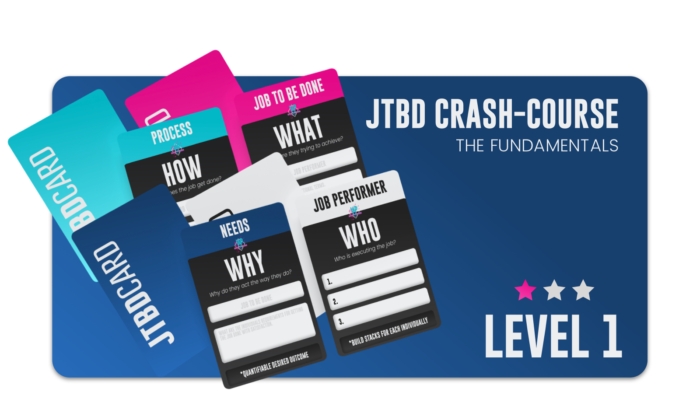
If after reading this you realize you're overwhelmed by micro-initiatives while your macro strategy languishes? Start where the 2% do: by nailing the core job-to-be-done before you fund another AI feature. Our JTBD L1 self-guided workshop gives you a structured way to define, validate, and pressure-test that core job, so every micro experiment, meso automation, and macro AI bet is anchored in a problem that actually deserves to be solved.
JTBD Fundamentals
$200.00
my 5 cents on industry matters
MORE LEMON SEEDS
THE WELLPAL long-form BUSINESS & BRANDING BLOG

The Underpants Problem: Why Your AI Adoption Strategy Has No Step 2
Most AI roadmaps have a Step 1 and a Step 3. The step that actually determines whether any of it pays out, Step 2, is missing. WPC Briefing №4 breaks down the three failure modes stalling organizations mid-transformation, and what it actually takes to close the gap between AI adoption and competitive advantage.

AI Strategy Delusion: Why 98% Fail at Coordination
AI strategy coordination fails 98% of companies—not from tech gaps, but coordination chaos across micro (employee tools), meso (processes), and macro (product AI). Here’s your triage system.
Change the Game
Stop letting outdated pricing myths trap your brand in race-to-the-bottom competition. Discover strategic frameworks that transform pricing from cost-cutting into competitive advantage and sustainable growth.

AI’s Role in Building Brand Equity
In this brief, we explore AI’s Role in Building Brand Equity —how it excels at execution but falters at intuition.
share this brief
custom
"Signal vs Noise” Reports
Get in touch if you’re Looking to Transform market chaos into operational clarity through custom Brand Navigator™-filtered insights.