
COPYRIGHT © 2025 WELLPAL CREATIVE
LightDark


“Build Instruments. Not Ornaments”
Featured
-

Couche-Tard Acquisition Strategy - Deep Dive Report
$290.00Original price was: $290.00.$200.00Current price is: $200.00. -
DIY Series - The MVB Kit
$25.00
Recent Lemon Seeds

Copyright © 2025|2026 WellPal Creative
The WPC Briefing | understanding the ripples of change
The AI Strategy Delusion
Why 98% of Companies Lose the 3-Front War
what are these?
Purpose of The WPC Briefing
a layered perspective
In this Briefing:
Most brands are delusional about AI. Not because they overestimate what it can do, but because they underestimate what it takes to make it matter. A recent recent MIT Technology report, in which only 2% of senior executives rate their AI performance as truly delivering strong, measurable results, exposes that belief as a delusion.

The trap: You read the headlines, hire a prompt engineer, slap a chatbot on your site, and call it "AI-first." Meanwhile, your core offer is still analog, your teams are siloed, and your processes can't scale a whisper. This isn't innovation, it's theater.
The WPC Briefing Series exists to give leaders a decisive edge. It doesn’t revisit theory or drown you in data for deep dives; there’s our Lemon Seeds. Instead, it distills emerging shifts in technology, culture, and competition into sharp, actionable insight. It’s brief by design. Readers already know the frameworks; what they need is a cheat sheet into WPC’s outlook on technology disruption, brand shifts, strategy, and business models, something they can use to spark discussions, refine direction, and navigate complexity with confidence.
table of contents
Jump Straight to the Essentials
Let's get into it
Executive Summary
Let’s forget the data problem for a minute.
The 2025 MIT Technology Review report “Building a High-Performance Data and AI Organization” reveals a stark truth: only 2% of leaders see strong business results from AI. The common diagnosis is a “data problem,” but that’s vague. The real, tactical failure is a coordination problem.
The widespread delusion in AI strategies is the belief that adoption alone guarantees results. This report’s finding exposes the fallacy. The real failure isn’t a lack of technology, but a fatal lack of coordination across the three simultaneous fronts of modern AI deployment when it comes to brand building and management.
"AI" shouldn't be approached as one initiative. It's a simultaneous, multi-front war being waged at three levels inside your company:
MICRO
- Employees using tools like ChatGPT (for copy, code, and brainstorming).
MESO
- Departments automating processes (marketing analytics, support ticket routing).
MACRO
- Your core product or service relies on AI for customer-facing value.
Micro reveals. Meso captures. Macro compounds.
Micro: Don’t ban employee tools like ChatGPT, “audit their usage”. The tasks they offload reveal your next possible product gaps. Meso turns that signal into departmental data streams. Macro delivers customer-facing intelligence built on reality, not theory.
Two Paths, One Model
The 98% vs. The 2%
Most organizations let these fronts evolve as uncoordinated experiments, burning resources without compounding learning. The 2% treat them as a single, stage-gated campaign, applying ruthless, stage-specific discipline to decide which front gets resources, which gets studied, and which gets shut down.
STAGE 1
The Feasibility Trap
Stage 1: Validation & Early Growth
Why “AI as a Product” Is a Lethal Distraction
Your Reality: You’re searching for Problem-Solution Fit.
“Data” here isn’t a pristine warehouse; it’s the messy, human “thoughts on a napkin” kind of stuff: customer interview notes, manual usage observations, spreadsheets of early transactions, and feedback scribbles.
The Multi-Front Triage
Stage 1
MICRO | AI for Employee Productivity
Don't ban it. Study it.
Are individuals already hacking AI under the radar (e.g., sales using ChatGPT for proposals)? If yes, standardize it. If no, you’re too early.
Their prompts and workarounds are a free, high-signal research feed into what they find tedious or valuable.
This is your “data” for potential future automation.
MESO | AI for Departmental Processes
Functionally nonexistent
Can AI automate your top 3 manual pains (e.g., content repurposing, lead qualification)? Without this, scaling is fantasy.
MACRO | AI as a Product Feature
This is a lethal distraction.
Does every AI feature tie directly to your job-to-be-done? (Anti-example: A wellness app’s “AI mood tracker” when users just want personalized workouts.)
It consumes capital and focus while your core job-to-be-done remains unvalidated.
This is the primary Feasibility trap.
Actionable Insight
Implement the “AI Feasibility Gate.”
Before any technical build, force the idea through a filter:
- Job Criticality
Does it solve the “core” customer struggle, or a peripheral one? If peripheral, kill it.
- Data Feasibility
Can we manually create the clean, specific input data needed (e.g., 100 tagged support tickets, categorized feedback) for 100 pilot users?
If not, you lack the foundation to build.
- The Compensation Test
What’s the current workaround? A spreadsheet? A gut feeling? That workaround is your true MVP. Automate “that” first.
The WPC Take
"AI is the cart. Your dirty, specific, problem-focused data is the horse".
Micro is your free research lab. Audit ChatGPT usage weekly, what tasks keep surfacing? Those are tomorrow’s meso automations and macro features.
Starve macro until it passes the Gate. No product AI until you can manually simulate it for 100 pilot customers with data you already have.
Your unfair advantage: a tiny, obsessively curated dataset linked to one validated customer job.

STAGE 2
The Desirability Dilution
Stage 2: Scaling & Market Penetration
When AI Becomes a Brand Integrity Challenge
Once you’ve validated the job, Stage 2 is about systematizing a winning play.
“Data” evolves into the quantified experience of your brand: customer behavior logs, support ticket histories, product usage streams, and CRM entries. This is your brand’s digital fingerprint.
But here’s the nuance branding demands (see our previous Briefing on AI’s Role in Brand Equity While AI optimizes the quantifiable (clicks, conversions), true brand equity lives in the psychological; feelings, rituals, and cultural tensions that defy perfect measurement.
Your governed AI platform doesn’t replace that human intuition, or at least it shouldn’t. It amplifies it, ensuring every macro AI interaction feels like a seamless extension of your archetype, not a generic chatbot.
This is why the right HUMAN in the “human-in-the-loop” matters more than ever, bridging psychological nuance to governed data flows.
The Multi-Front Triage
Stage 2
MICRO | AI for Employee Productivity
Move it from shadow IT to sanctioned use.
Are AI guardrails (IP protection, brand voice) non-negotiable across functions? No? You’re leaking value.
Provide approved tools, brand-aligned templates and process decks, and clear IP/security guardrails. Turn grassroots energy into aligned momentum.
MESO | AI for Departmental Processes
This is where you harness the chaos
Does AI connect silos (e.g., supply chain + marketing for dynamic pricing)? Otherwise, you’re scaling friction.
Audit the tool fragmentation, kill redundant vendors, standardize the winners, and mandate that their data outputs feed your central platform. This is the fight against fragmentation.
MACRO | AI as a Product Feature
Now your primary strategic battlefield.
Is AI the invisible backbone of penetration plays (e.g., hyper-personalized bundles)? If it’s still a gimmick, pivot.
It must be built on a governed data platform and be inseparable from your brand promise. Here, AI becomes a direct driver, or destroyer, of Desirability.
Actionable Insight
Govern AI as a Core Brand Attribute.
Your AI’s behavior is part of your brand experience.
- Micro | Guardrail Compliance
Are employees using AI in ways that risk IP leakage, hallucinated facts, or brand voice inconsistency?
- Meso | Process Integration
Are your departmental AI tools (marketing, sales, support) creating isolated silos, or contributing to a unified customer view?
- Macro | Brand Alignment
Does your product’s AI reflect your brand archetype? Is your “Sage” chatbot actually wise, or just generic?
The WPC Take
AI is now your brand's mirror.
One generic chatbot response = one brand equity leak.
Macro is your flagship. Every customer-facing AI touchpoint must scream your archetype or identity, test it against your brand voice guidelines weekly.
Meso is your integration war. Audit tool sprawl monthly. Kill redundancies. Mandate all outputs feed one governed platform.
Micro is your guardrail system. Sanction 3 approved tools max. Brand-aligned templates. IP ownership in every prompt.
Your moat: coherent AI expression from employee screen to customer experience.
Use the prompts in each cell to list your current AI initiatives across Micro/Meso/Macro and your actual stage. Expect to spend 10-15 minutes mapping them out. You'll surface obvious misalignments—like Stage 1 companies building macro features or Stage 2 teams ignoring meso sprawl. Screenshot and start now.
synthesis
The Stage Flip That Separates Winners
Synthesis
The winning pattern is flipping priorities as you cross stages.
Micro, meso, and macro efforts exist everywhere. The difference is ”when” each dominates.
Stage 1 demands feasibility.
You can’t build macro product AI when your core job-to-be-done isn’t proven. You won’t have meso processes worth automating. But micro experimentation, your team’s ChatGPT prompts and workarounds, is free intelligence about tomorrow’s opportunities.
Stage 2 demands desirability.
Now macro AI becomes your brand’s front line. Meso processes must feed one governed platform, not fragmented vendors. Micro tools get guardrails to protect your voice and IP.
The 2% don’t “do more AI.” They ruthlessly prioritize “one front per stage”.
This diagnostic reveals your reality: Are you fighting all three battles simultaneously? Or dominating the right one for where you actually are?
end of briefing
The Patience to Win the Right War
conclusion
Effective Diagnostic Questions for Leaders
The greatest modern competitive advantage is the strategic patience to ignore urgent, shiny fronts in order to secure the foundational ones.
The Killer Diagnostic Questions
For the Stage 1 Leader
Are we using ‘AI’ as a noun (a thing we build) to avoid the hard work of validating the verb (the job we solve)?
For the Stage 2 Leader
If we turned off all our AI tools tomorrow, which level, micro, meso, or macro, would cause our brand promise to collapse fastest?
The work isn’t about keeping pace with AI. It’s about having the clarity, and the courage, to know which front deserves your crown jewels: your time, your data, and your brand equity right now.
Found this insightful?
Share it with your network!
see you in the next briefing
Reccomended Essentials
Deepen Your Strategic Edge
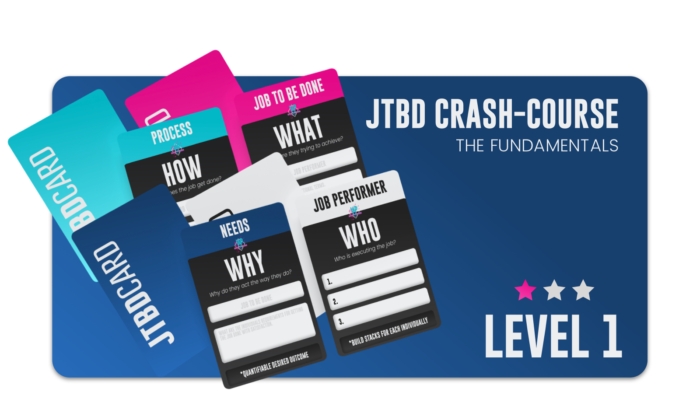
If after reading this you realize you're overwhelmed by micro-initiatives while your macro strategy languishes? Start where the 2% do: by nailing the core job-to-be-done before you fund another AI feature. Our JTBD L1 self-guided workshop gives you a structured way to define, validate, and pressure-test that core job, so every micro experiment, meso automation, and macro AI bet is anchored in a problem that actually deserves to be solved.
JTBD Fundamentals
$200.00
WELLPAL SOLUTION SUITE
Interested to see how WPC can help you?
find out below or contact me.
-
1 solution
WPC Ideation & Prototyping (WIP)™
WellPal Ideation & Prototyping (WIP)™ is designed for dreamers and doers alike. Whether you're a startup looking to disrupt the market, a new business aiming to refine your brand, or an established company exploring new horizons, i’m here to help bring your vision to life.
-
2 solution
WPC Brand Navigator™
At the heart of the WPC Solution Suite is the Brand Nav approach, a brand business model tailored for elevating brand equity beyond just the operational aspect. Unlike traditional models, our Blueprint Navigator intricately blends strategic business insights with emotional customer engagement, ensuring your brand not only resonates but also endures.
-
3 solution
WPC Brand Evolution Suite™
WellPal Brand Evolution Suite™ is designed for brands at a crossroads, contemplating a fresh direction. Whether you're a brand who needs an identity refresh, or an established company exploring new horizons, or simply looking for strategic clarity in the clutter, i’m here to help bring your vision to life.
-
4 solution
WPC Visuals
WellPal Brand Visuals is simply the design and graphic aspect of the solution suite. It's for brands craving visual distinction. Beyond aesthetics, we craft visuals that encapsulate your essence, making every interaction across multiple touch points memorable. Brand identity design, visual identity design, UI Design and development, GFX design
my 5 cents on industry matters
MORE LEMON SEEDS
THE WELLPAL long-form BUSINESS & BRANDING BLOG

AI Strategy Delusion: Why 98% Fail at Coordination
AI strategy coordination fails 98% of companies—not from tech gaps, but coordination chaos across micro (employee tools), meso (processes), and macro (product AI). Here’s your triage system.
Change the Game
Stop letting outdated pricing myths trap your brand in race-to-the-bottom competition. Discover strategic frameworks that transform pricing from cost-cutting into competitive advantage and sustainable growth.

AI’s Role in Building Brand Equity
In this brief, we explore AI’s Role in Building Brand Equity —how it excels at execution but falters at intuition.
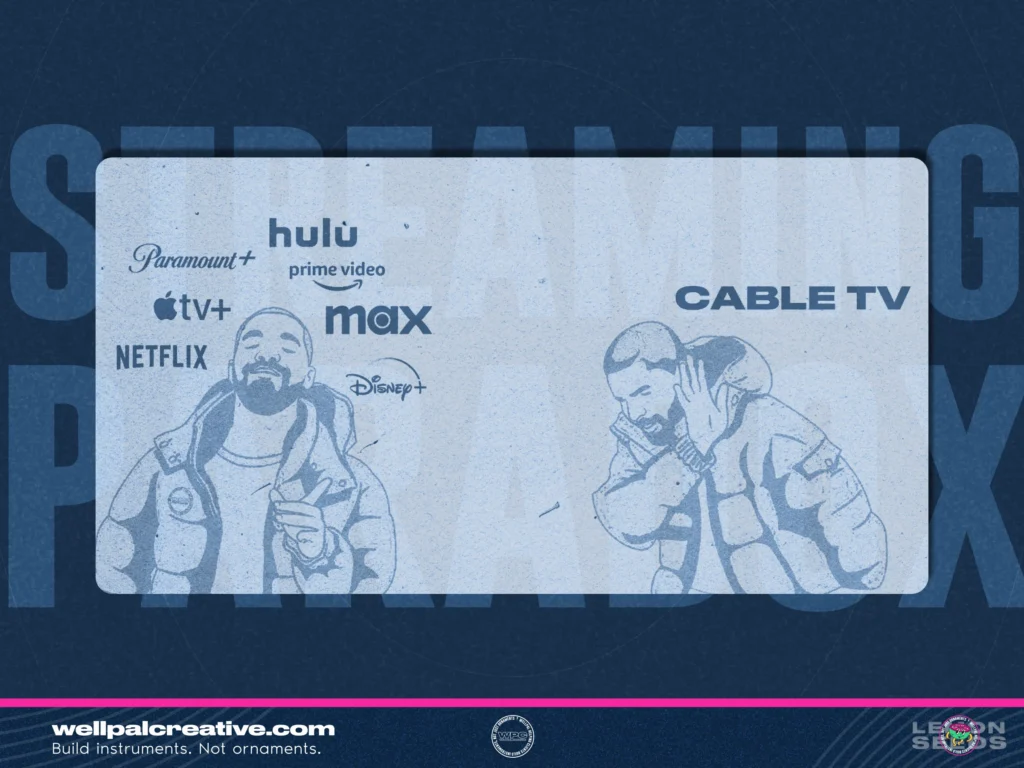
The Streaming Paradox: Convenience vs. Complexity – [LS18 ]
Discover how platforms that once revolutionized media consumption are now grappling with challenges reminiscent of traditional cable models.
share this brief
custom
"Signal vs Noise” Reports
Get in touch if you’re Looking to Transform market chaos into operational clarity through custom Brand Navigator™-filtered insights.