Course Content
Introduction
Here we will cover a brief introduction about WellPal and how this course came to be.
0/3
1. JTBD Theory 101: Understanding How Customer Needs Drive Business Growth
Objectives: 1. Understand the origin of the Jobs To Be Done (JTBD) theory. 2. Learn the core principles of the JTBD theory. 3. Understand the core concept of ‘job stories’ and how it’s used in the JTBD framework.
0/7
2. Understanding JTBD: From Discovering Customer Needs to Creating a Unique Value Proposition
Objectives: * Understand the concept of the "job" and its role in the JTBD Theory * Understand the different types of jobs that customers may hire products or services to do * Understand the factors that influence the choice of a product or service to do a job * Be able to apply the concept of the "job" to identify potential solutions for a specific product or service category
0/5
3. Recognizing JTBD: Techniques to Improve Your Customer Value
Objectives: 1. Understand how to use JTBD to better understand customer needs and motivations 2. Understand the importance of considering the context in which customers make decisions 3. Develop a deeper understanding of the "jobs" that customers are trying to do with your products and services. 4. Techniques on discovering them
0/4
4. Applying JTBD: Actionable templates to drive business success
Remark: Lesson 4 is designed for entrepreneurs who have a basic understanding of JTBD theory and are looking to refresh their skills or quickly digest key actionable insights. As a result, some of the content covered in this section may seem familiar from previous lessons. However, this repetition is intentional, as it allows you to reinforce your understanding of the material and apply it more effectively to your business. Should you ever need to revisit specific concepts or techniques, you can easily do so by reviewing the lessons within Lesson 4. Introduction: In the previous three lessons, we've covered the basics of the Jobs-to-be-Done theory, including how customer needs drive business growth, techniques for discovering and creating unique value propositions and recognizing customer needs and motivations. Now, it's time to put these concepts into practice with a set of actionable templates. In this lesson, you'll learn how to conduct a basic level JTBD interview to get to know your customers and their jobs, build purpose-driven brands with the job story framework, anticipate and identify competition to stay ahead in the market, align your business and brand strategy with your customers' jobs, and speak your customers' language with effective marketing strategies. Let's get started!
0/9
JTBD Fundamentals

Introduction

By understanding the following principles, you can better understand the needs and motivations of your customers and create offerings that more closely align with their needs. Understanding these principles will also aid you in anticipating “innovation opportunities” for your own solutions. 

I will highlight each principle with a real-life brand example. In my experience this helps people grasp and relate to theory much easier. 

From there on we will touch on some of the practical links between practice and theory. 

Limitations

The JTBD framework, just like any other framework or model in business, is not a guaranteed answer to every problem or question. 

So if you are looking for it to be a Swiss army knife to be used for all your ideas, you will be disappointed at some point

There is actual value in sometimes hiring professionals to help you navigate which solution or tool is best suitable for your specific case. For this, you can simply inquire about 1:1 strategy consultations, and in a joint effort, we create custom solutions.

JTBD is a general framework that can be applied to most consumer businesses and even B2B ones, the trick is for you to understand the essence of this framework and be able to know where its limitations are for your scenario and hire help where truly needed.  

Every theory is built in a certain vacuum and tested and iterated over time by individuals and their experiences. At WellPal the same has happened with our Brand Blueprint Model which is my own trial-and-error iteration of the Business Model Canvas that presented limitations in the context of building businesses as Brands. 

I encourage you to challenge yourself, be critical, and iterate upon this to build out your perfect instrument. 

The 4 core principles overview

You can use the cheatsheet below for a birds-eye overview of the 4 core principles. 
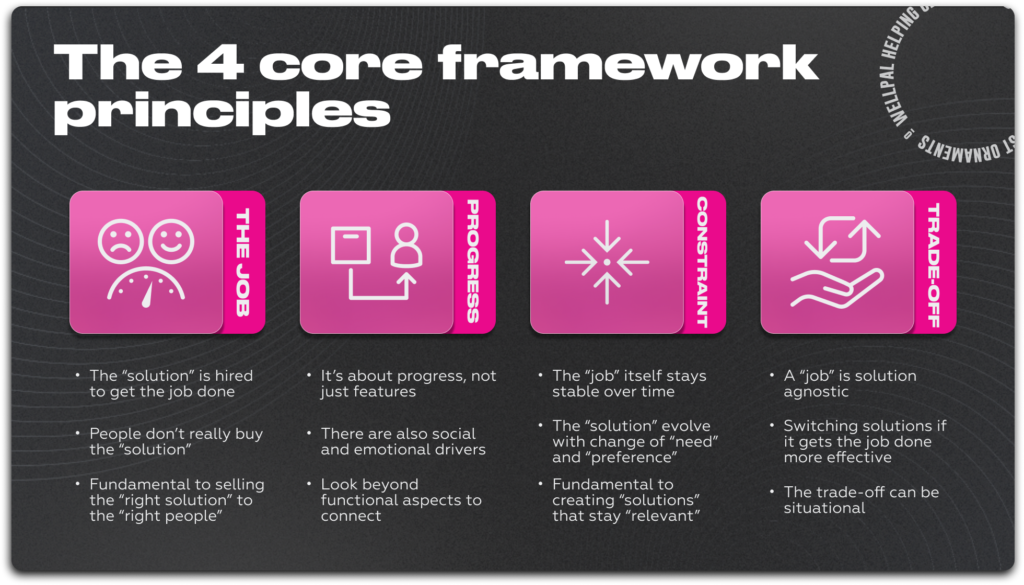
Let’s proceed to the next lesson and dive into the first principle and its practical application. 

0% Complete